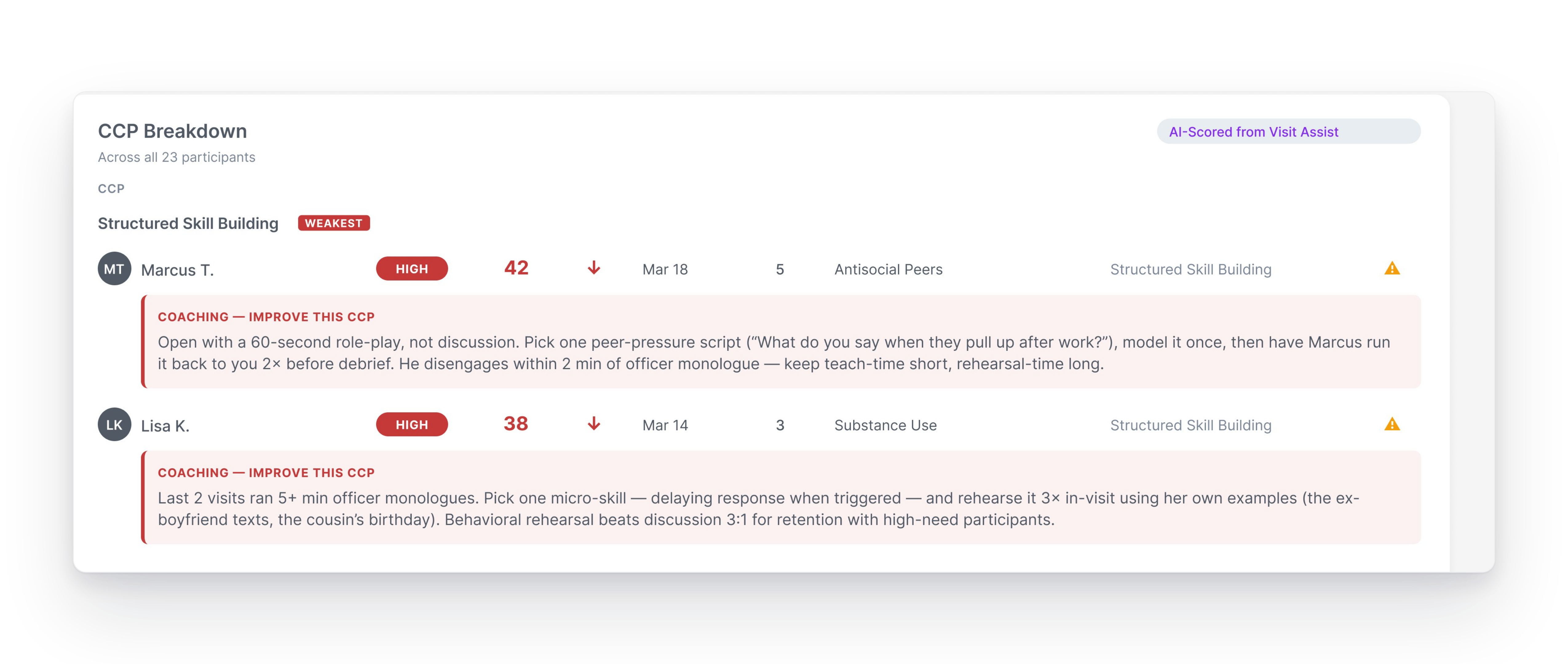
Practice becomes a profile. The profile becomes a coaching target.
The Officer Performance pillar turns supervision data into specific, prescriptive coaching.
Practice becomes a profile. The profile becomes a coaching target.
Agencies invest heavily in evidence-based practice training. Officers complete EPICS or MI or STARR. Coaches certify. Policy gets updated. The training-to-classroom link is solid.
The training-to-field link is invisible. Without a way to score what officers actually do in front of participants, leaders cannot tell whether training landed, which officers absorbed it, or where the gap is widest.
A complete picture of an officer's practice. Updated with every visit.
Every officer carries a Supervision Quality Score. Reinforcement balance, case plan progress, and referrals sit alongside, with strongest and weakest CCP surfaced explicitly and a specific recommended coaching action drawn from the officer's recent visits.
Trajectory is visible. Is this officer's SQ trending up over the last 90 days, flat, or declining. Is the weakest CCP improving with coaching or stuck. The profile is the operating record of an officer's professional development, grounded in evidence-based practice and refreshed with every contact.
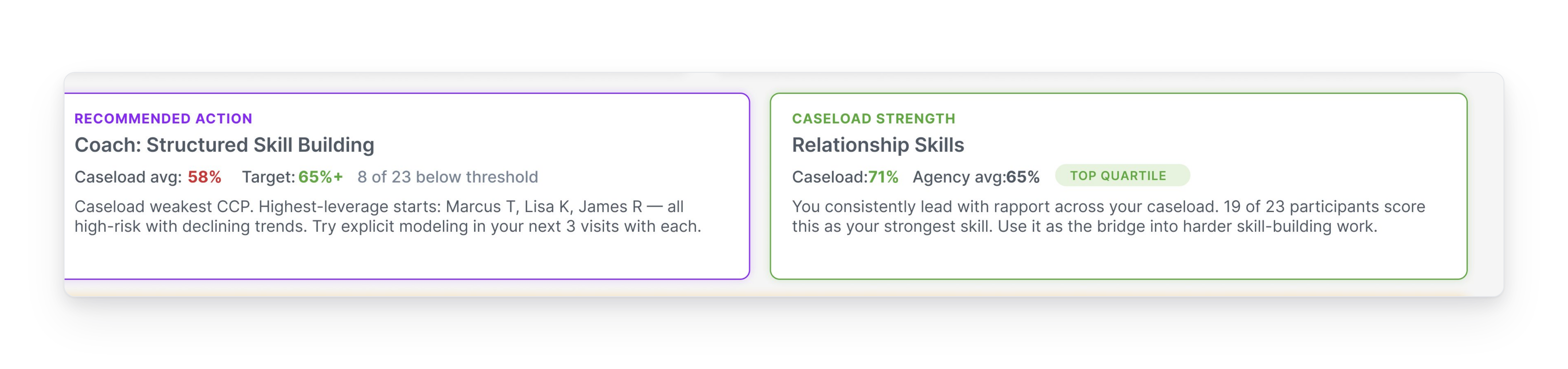
Supervisors stop running 1:1s on the visit they happen to have observed. The platform surfaces who needs coaching, on what, and pulls the specific visit excerpt where the coaching moment lives. A supervisor walks into the 1:1 with the exact two-minute clip from yesterday's visit, the scored gap, and a recommended next step.
Five hours per supervisor per week returned. Stop building spreadsheets. Start coaching the practice that moves outcomes.
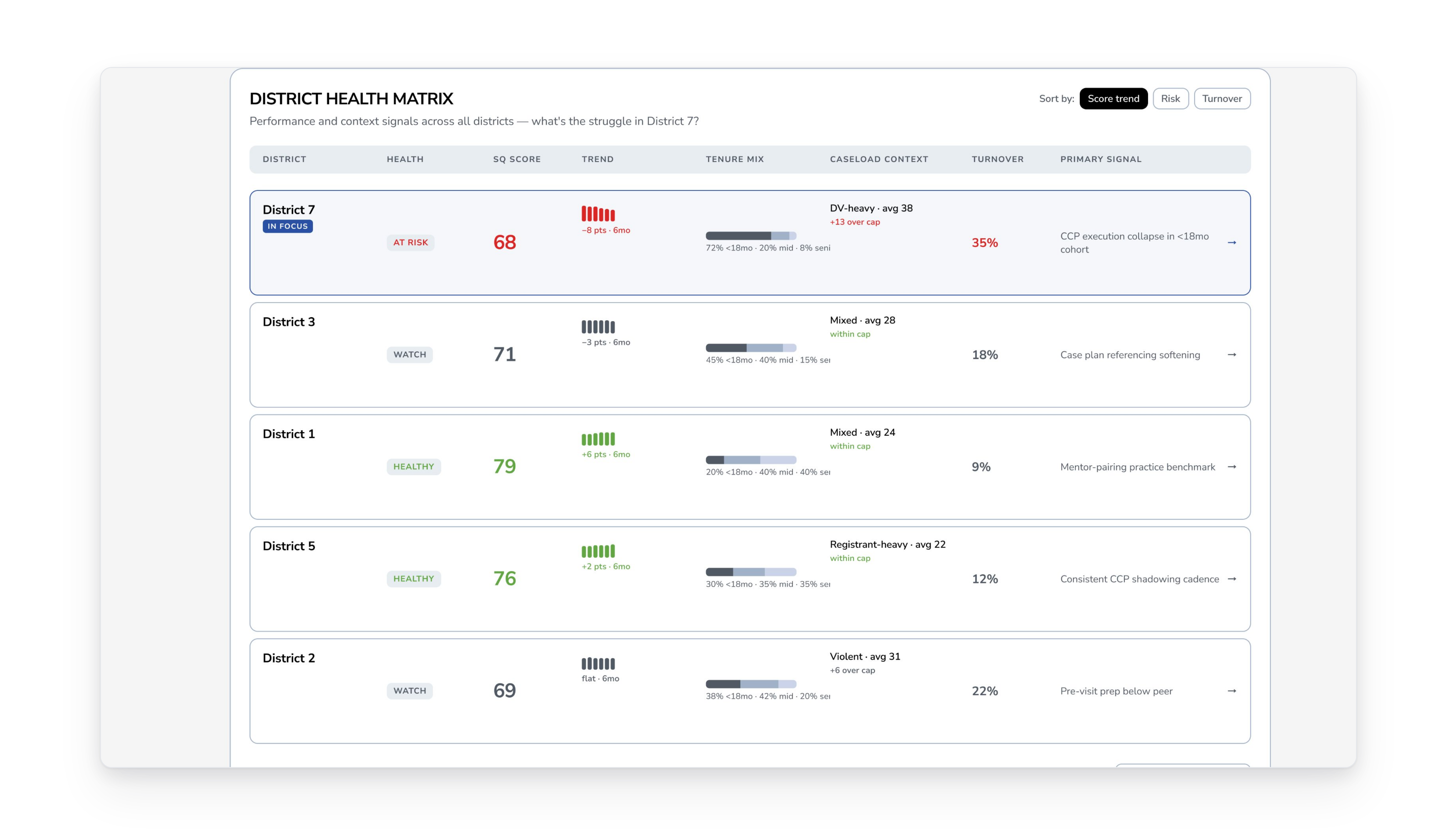
Where to invest first. Which district is moving. Which is stuck.
The same scoring system that profiles an officer rolls up to a district. Leaders can compare on practice quality, not outcome lag. Identify the district where coaching investment will return the most. Spot the district that needs leadership intervention before outcomes confirm the gap.
Strong practice. Continued reinforcement. Mentorship of newer officers. Opportunities to model practice at trainings.
Specific gaps to develop. Targeted coaching with recent visit examples. Quarterly check-in on trajectory. Named CCPs to build.
Structured coaching support. Weekly coaching with named practice gaps. Visible improvement window. Documented support that strengthens both the officer and the team.
Supervision Quality supports coaching and development. It is not a formal performance-evaluation instrument.
Twelve months of practice data underpin every coaching conversation, not a manager's recollection. Officer trends visible over time. Coaching impact visible across the team. The agency knows whether its development investment is working at the contact level, not just the policy level.
Three connected layers. One operating view.
The quality of the work being done. Evidence-based fidelity scored at every contact.
Explore the pillar →You are here. How individual officers are doing, where coaching lands, where to invest.
Who is being supervised. What is happening to them. Where outcomes are moving.
Explore the pillar →Shape the product. Get it first. Lock in the rate. Design partners get early access to RePath Intelligence, direct influence on the V1 roadmap, and anchor pricing that holds through general availability. Limited to a small number of agencies in 2026.