Know who to drug test before the test
Flag likely impairment without a physical test, from normal use of the platform. Used across 125+ agencies.
Book a Demo Run the ROI numbers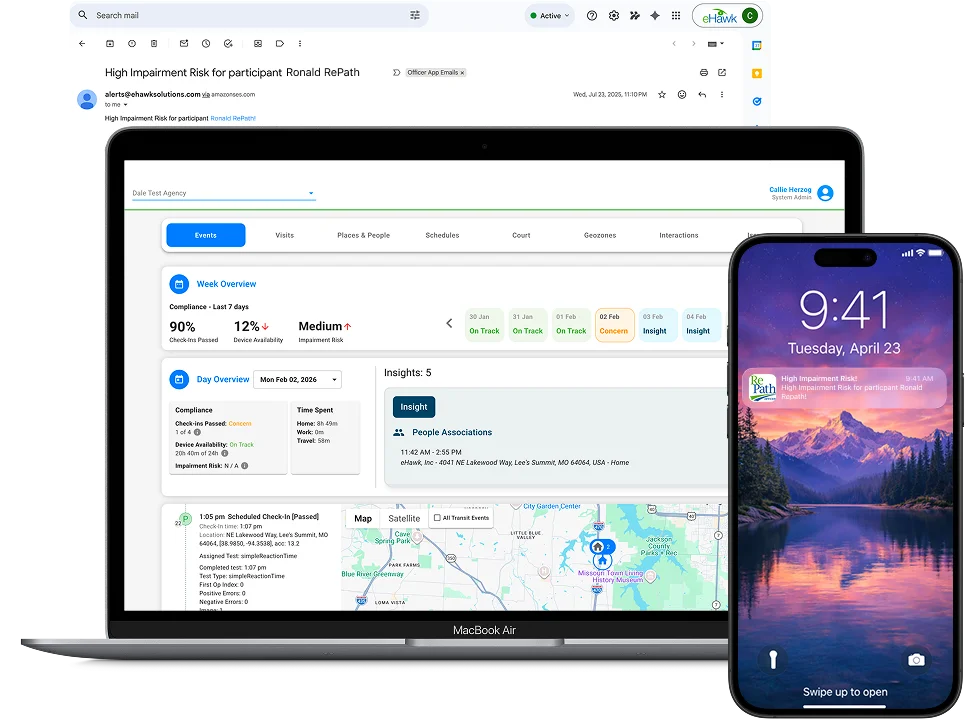
The Testing Problem
Random drug testing catches issues too late. Agencies waste resources on unnecessary tests while missing the participants who need intervention most.
Reactive, Not Proactive
Traditional testing only reveals substance use after the fact. By the time a test comes back positive, the opportunity to intervene early is gone.
Wasted Resources
Random testing means testing participants who don't need it while missing those who do. Agencies spend thousands on tests that return negative.
Untestable Substances
Standard panels can't detect inhalants, certain designer drugs, or rapidly metabolized substances. Impairment goes undetected.
No Predictive Insight
Without data-driven risk assessment, officers rely on gut feeling to decide who to test and when to intervene.
How Impairment Risk Works
Behavioral Patterns
RePath monitors behavioral patterns through regular supervision interactions, automatically, without additional burden on officers or participants.
ML Analyzes Patterns
Machine learning analyzes behavioral patterns and identifies risk signals in real time.
Risk Alert Triggered
When risk signals emerge, the system flags the participant as Low, Medium, or High risk and notifies the officer immediately.
Officer Intervenes
Officers receive alerts and take action. Schedule a check-in, order a test, or connect the participant with treatment resources.
Impairment Risk is powered by behavioral supervision data collected through normal platform use. No additional burden on officers or participants, and no physical testing required.
Want to see Impairment Risk in action?
Book a DemoWhat Impairment Risk Does
No Physical Test Required
Behavioral pattern monitoring runs through the RePath platform. No cups, no swabs, no lab costs.
Detects All Impairment Types
Catches substance use, fatigue, medication effects, and stress. Not limited to what a urine panel can detect.
Personalized Baselines
Risk assessment is calibrated to each individual, not a population average, making signals more accurate and actionable.
Real-Time Alerts
Officers get notified immediately when risk levels change. No waiting for lab results.
Low/Medium/High Scoring
Clear, actionable risk levels. Officers know exactly how to respond at each threshold.
Privacy-Conscious Design
The tool identifies functional impairment, not specific substances. Focused on risk, not surveillance.
What Impairment Risk Does and Doesn't Do
What It DOES
Predicts likelihood of impairment
Catches 4 in 5 confirmed events
Detects untestable substances
No physical screening needed
What It DOESN'T Do
Not continuous real-time monitoring
Doesn't prove cause of impairment
Not a replacement for drug testing
Not court-admissible evidence alone
What we measured
3 in 4
high-risk flags that get tested come back positive
4 in 5
impairment events a test can confirm are caught
75 min
a week back for one drug court coordinator from automated test scheduling
Every
test one Missouri juvenile officer ran on a high-risk flag came back positive
12
medications confiscated after a flag exposed prescription misuse the drug tests missed
0
cups, swabs, or lab fees. It runs on normal use of the platform
What Officers Are Saying
"I was suspicious about a participant and whether they were sober, but it wouldn't show up in the UAs. [Impairment Risk] caught it though and helped prove my suspicions! I received a notification that she was flagged as high risk for impairment... I confiscated 12 prescription medications."
"We had a lady that was approved to take one diet pill a day and RePath was able to tell us there was an issue and turns out she was taking more pills each day."
"The very first kid we had on IR was a kid we did not suspect was using. However, he had been exposed to methamphetamine... that really got us to be at the heart of the issue."
"So far every test has come back positive when flagged in RePath, so we have really enjoyed that additional data."
"I got my first 'possible impairment' notification over the weekend. Sure enough, it was accurate! It was a legitimate impairment because he has significant medical issues."
Where agencies use impairment risk
Questions about impairment risk and drug testing
What is impairment risk in community supervision?
It's a flag that tells an officer who may be impaired, scored Low, Medium or High from normal use of the RePath app. There's no cup, swab or lab fee. When a high-risk flag gets tested, three in four come back positive.
Does impairment risk replace drug testing?
No. It tells you who to test and when. One juvenile officer in Missouri started testing whenever RePath flagged high risk, and every one of those tests came back positive.
Can it catch what a drug test misses?
Yes, because it flags impairment, not a specific substance. One treatment court caught a participant huffing compressed-air dusters, which no panel screens for. The same court caught a participant misusing diet pills.
How do drug courts use impairment risk?
The coordinator sees the flags each morning and decides who to call, visit or test, and automated test scheduling handles the rest. Impairment Risk catches four in five impairment events that a test later confirms.
What happens after a flag?
Usually a conversation before a violation. A court services director in Alabama got her first alert the weekend after training. It was a medication change, and it ended with a doctor's visit, not a sanction.
Ready to predict risk before it becomes a violation?
Book a demo to discover how Impairment Risk can transform your agency's supervision approach.
Book a Demo