What's happening in supervision is no longer invisible.
The interactions between officers and participants have always been the work. Now they are the data.
From contact counts to practice.
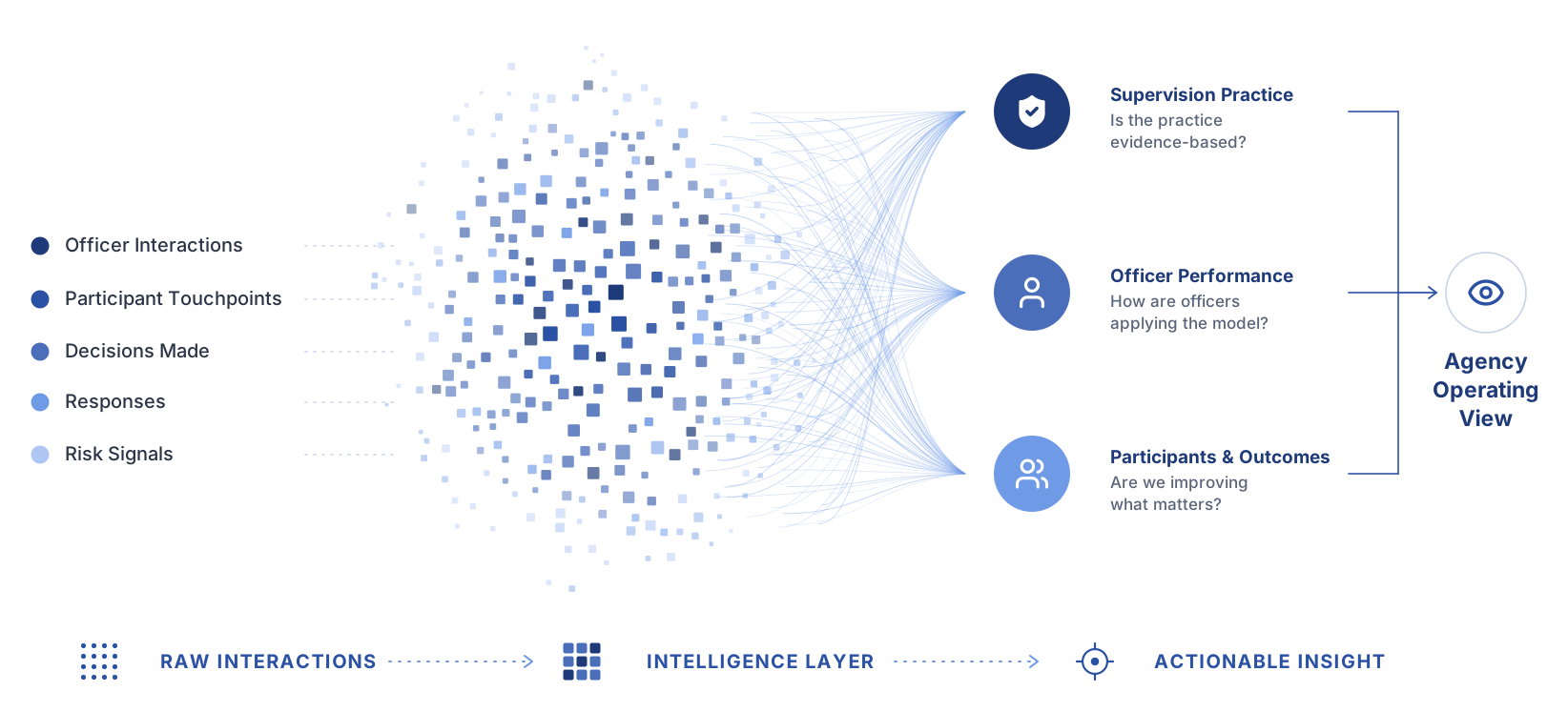
Every supervision interaction becomes structured signal. Officer Interactions, Participant Touchpoints, Decisions Made, Responses, Risk Signals · all captured as the visit happens.
The blind spot.
Most agencies see dashboards full of compliance metrics. Contact counts. Completion rates. The CMS records that a visit happened on the date it was supposed to happen. What it cannot tell anyone is how the visit went.
Today, supervisors review only a small fraction of officer meetings through manual QC sampling. The vast majority of supervision happens with no observation, no scoring, and no operating-level visibility.
Agencies invest heavily in evidence-based training. They publish policy. They build supervision standards. But the gap between the standard and the practice is invisible until it shows up in a revocation rate, a legislative inquiry, or a recidivism trend. By then it is too late to act on.
The shift.
Visit Assist sits inside every supervision contact. It captures the conversation, the case plan reference, the next-steps language, the reinforcement balance, the skill execution. RePath Intelligence scores it against evidence-based standards grounded in APPA national policy and Core Correctional Practices research.
Every visit produces a structured scorecard. Every officer rolls up to a profile. Every district rolls up to a benchmark. Every agency rolls up to one operating view.
This is not surveillance. It is the same observation that supervisors do today, scaled from a thin manual sample to 100 percent. The work officers already do becomes the data leaders need.
What changes when practice is observable.
Legislative response time collapses from days to minutes. A deputy secretary can answer a committee question about supervision quality with district-level evidence, not a CMS extract that returns different numbers depending on who pulls it.
Resource decisions stop being guesses. Investment moves toward the practice gaps that drive outcomes, not the districts that complained loudest. Coaching has a target. Supervisors stop running 1:1s on whatever they happen to catch in a sample and start running them on specific, scored, recent practice.
Most agencies have no reliable way to track how often officers address high-risk behaviors, practice skills, or work criminogenic needs. The practice is real. The visibility is not.
Why only RePath.
The interaction dataset is the foundation. Every other supervision intelligence product builds from data the agency already had. RePath Intelligence builds from data only RePath captures, generated at zero extra officer burden.
Continue the sequence.
See. Measure. Coach. Improve. Each stage builds on the last.
Become an Intelligence design partner.
Shape the product. Get it first. Lock in the rate. Design partners get early access to RePath Intelligence, direct influence on the V1 roadmap, and anchor pricing that holds through general availability. Limited to a small number of agencies in 2026.