Community supervision is entering an evidence-led era
The field has taught evidence-based practice for decades and mostly measured whether contacts happened. Budgets, research and new data are closing that gap. Here is what it asks of agency leaders.
For most of its history, community supervision has been judged by activity. Contacts made, drug tests given, violations filed, cases closed. Those numbers are easy to count, and they say very little about whether supervision worked.
That is changing. Budget offices want to know what supervision buys. The research now says which parts of supervision change outcomes. And for the first time, agencies have the data to see those parts happen. All three point the same way: from “did the contact happen” to “did it help.”
Budgets now ask what supervision buys
The Council of State Governments Justice Center tracks what supervision failure costs. In 2021, supervision violations drove 44% of state prison admissions. States spent more than $10 billion that year incarcerating people for violations, and more than $3 billion of it was for technical violations like missed appointments and failed tests.
On any given day, about 1 in 4 people in state prison are there because of a supervision violation
1 in 4state prison beds held for a supervision violation, 2021
Legislators and budget staff read those numbers. When a supervision agency asks for positions or technology, the follow-up is no longer how many people it supervises. It is what changes for those people, and how the agency knows.
Training pays off only when the skills show up in the room
Most agencies have already invested in evidence-based practice. Officers are trained in motivational interviewing and core correctional practices through models like EPICS, STARR and STICS, and the research behind that training is real.
It also comes with a condition. A 2022 meta-analysis in Justice Quarterly by Ryan Labrecque, Jill Viglione and Michael Caudy pulled together 25 studies of officer training programs. Training changed how officers ran their sessions, and it reduced rearrest and reconviction. Where officers actually used the skills, the effect was far bigger.
Officers who used the skills well cut rearrests more than three times as much
So the training money pays off in the conversations where officers actually use what they learned. Most agencies can’t tell which conversations those are. Quality review usually means a supervisor reading a small sample of case files weeks after the visit, and a case note describes the conversation without showing it.
Some of the evidence is already settled
Not every question needs a new study. Some supervision tools have been tested in randomized trials, the strongest evidence social science produces.
Reminders are the clearest case. A 2025 trial in Santa Clara County, published in Science Advances, found automated court reminders cut warrants for missed court dates by about 20%. A 2021 trial at Arkansas Community Corrections found text reminders cut missed supervision appointments by 29 to 30%.
Preventing a missed court date costs a fraction of what one costs
An evidence-led agency doesn’t wait for perfect proof on everything. It funds what already has it and measures the rest.
The data to measure practice finally exists
Supervision was judged by activity because activity was all anyone could see. What happened inside a home visit or an office check-in lived in the officer’s memory and a short case note.
Smartphone-based supervision changes what gets recorded. The National Institute of Justice’s 2023 brief on smartphone applications for community supervision describes the category as a cost-effective way to supervise remotely, with check-ins, reminders, location and goal setting on the phone a person already owns. Each of those leaves a record. When visits are recorded and summarized, the conversation itself becomes something a supervisor can review and an agency can measure.
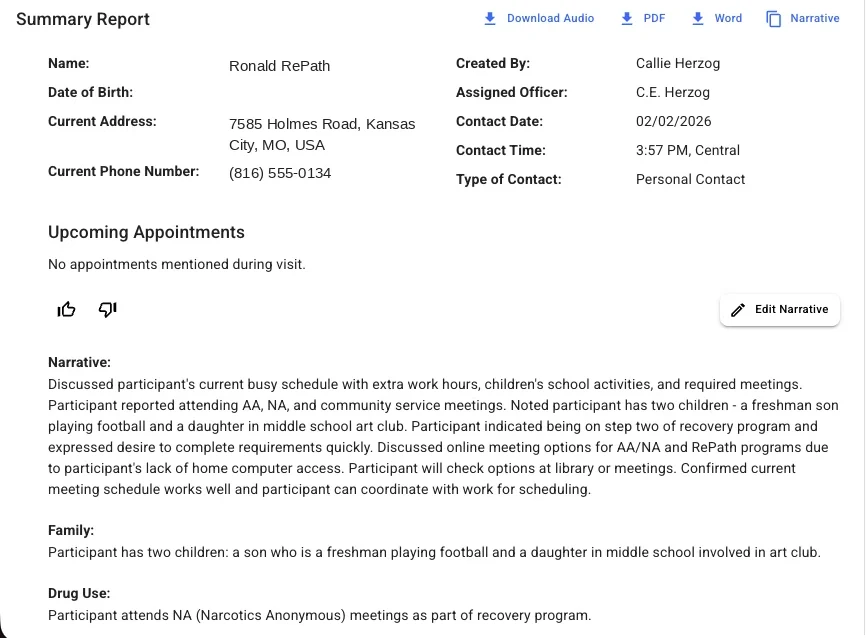
The timing matters for a second reason. Measuring practice means little if officers have no room to practice. One county corrections department ran a time study on its own officers and found 72.7% of their time went to administrative and system work, and only 18.7% to direct supervision.
A state deputy secretary of corrections, after seeing what that looks like across an agency:
“This presents a solution for quality assurance, evidence-based practices, and recouping time for staff. It’s a product that helps me specifically implement evidence-based practices.”
What an evidence-led agency does differently
It measures practice as well as activity
Contacts still count, but the agency also knows whether officers are using the skills it trained them on, across the whole caseload instead of a sample.
It puts money behind what has evidence
Reminders, structured sessions and coaching tied to real conversations all have research support. A tool that can’t say what it changes goes to the back of the line.
It protects officer time
Skills need minutes in the conversation, and an agency that leaves officers buried in data entry is paying for training it can’t use.
It asks vendors for evidence that holds up
The question for any vendor is what was measured, where, and what changed, and whether the answer would hold up in a procurement meeting. Testimonials help, but they don’t answer that.
What doesn’t change
Evidence informs judgment. It doesn’t replace it. Officers still decide what a participant needs, when to give someone room and when to step in. Good measurement shows a supervisor where to coach and shows a director where to put the next dollar. Officers can tell coaching from a gotcha, and the agencies that get this right make sure it reads as coaching.
The agencies that get there first will have something the rest won’t: a real answer when the budget office asks what supervision buys.
Read next
Want to see what your agency could measure?
A 30-minute walkthrough on an agency like yours, with the math on your numbers.
Book a Demo Run the ROI numbers