The first 30 days: adoption and implementation
Whether a supervision platform works is decided in the first month, not the first year. Here is what the first 30 days look like at the agencies where officers actually use it.
Every agency leader has bought software that officers stopped opening by the second quarter. The contract ran its term, the vendor sent a renewal, and nobody could say what changed. So when a director asks us how long implementation takes, the real question underneath it is whether this one will stick.
The honest answer is that it depends on about five decisions, and all of them get made in the first 30 days. We have watched the same pattern hold across a state corrections department, a statewide juvenile agency, and county programs of every size. Agencies that make those five decisions get adoption in weeks. Agencies that skip them get a pilot that drifts.
Adoption is decided in the first two weeks
When a state corrections department took RePath statewide this year, its largest field office opened cold in August, about 1,500 people on supervision and officers who had not been part of the pilot. In two weeks, enrollment went from 37% of the caseload to 76%. That was above where the pilot had finished.
The largest office passed the pilot’s adoption rate in its second week
Nothing about that office was unusual. What was unusual was the setup: the expectation was set before day one, the office had been through training, and RePath staff were in the building for the first two weeks. The result showed up fast because the decisions had been made early.
The opposite is just as fast. An office that goes live with a login email and no training is at the same enrollment rate in month three that it reached in week two.
Enroll whole caseloads, not a pilot inside the pilot
The most common mistake we see is an agency that buys the platform and then hands it to three officers, who each put four people on it. Three months later, nobody can tell whether it worked, because it was never given enough of the caseload to show anything.
The agencies that get results do the reverse. In the state pilot above, enrollment was voluntary for the person on supervision and the officers offered it to everyone. 70% opted in. One Kansas juvenile office has more than 80% of its caseload on the platform, and some families bought a phone specifically so their kid could take part. A rural Missouri pretrial program enrolls from the bench: “I sign people up in court, a line of them, and they’re all done in five minutes.”
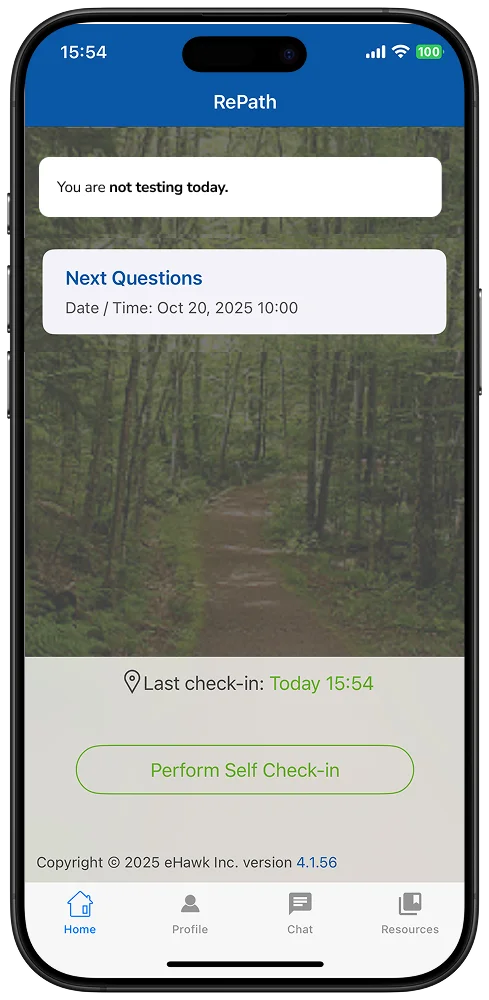
The rule is simple. Give it the whole caseload for every officer who is on it. A platform that touches a handful of cases cannot return hours to anyone.
A memo from the top, then training in every office
A leadership memo on its own gets compliance. Training on its own gets a few enthusiasts. Together they get adoption.
When the director of a statewide juvenile justice agency set the expectation in writing and RePath trained every office in person, the agency enrolled 1,445 young people in a single month. Officer activity rose in eight of its ten offices. The office that had barely used the platform went to the highest volume in the system.
That is the answer to “how do we make sure people actually use it.” Say it from the top, in writing. Then put a trainer in every office, not a webinar link in every inbox.
Tell officers what they get, in their own terms
Officers do not adopt a platform because leadership bought it. They adopt it when they can see what it does to their own day: fewer notes written at the weekend, less scanning, a shorter drive, a message answered instead of a voicemail.
The agencies that say this out loud, in training and in the memo, get adoption. The ones that leave it implicit get people logging in because they were told to. An officer in that state’s largest office, on his first day with RePath, hit a participant with no phone number and said out loud, “now I’m going to have to write my notes again.” By day one, writing the note had already become the exception.
“The more we use it, people in our office here are just digging it. It is selling our office wholeheartedly.”
Put someone in the building
Onsite presence in the first two weeks is the cheapest adoption lever there is. Questions get answered at the desk instead of in a ticket. The skeptical officer gets shown rather than told. The front desk learns the new routine while someone is standing next to it.
It also lets good ideas travel. During the pilot, an officer in one office pulled the paper report forms out of the lobby so that people defaulted to checking in on the app. When the largest office went live months later, they copied her on day one. A champion in every office carries that kind of thing sideways, and it is worth naming one before go-live.
The outcomes show up where the engagement is
In a six-district juvenile pilot in Kansas, the site that averaged 85% compliance against a 70% baseline was the site whose officers used the platform most. Across the whole pilot, 16 court hearings came up and not one was missed. Those are the numbers leadership wants. They came from the sites that did the first 30 days well, and they did not come from the sites that did not.
Across the Kansas juvenile pilot, 16 court hearings and not one missed
16 of 16court hearings kept across six judicial districts, January to May 2025
That is the whole argument for treating implementation as the project, not the thing that happens after the project. The outcome numbers are downstream of adoption, and adoption is downstream of five decisions made in the first month.
What the first 30 days look like with RePath Assist
This is the sequence we run with every agency, and it is the same whether the agency is a four-county district or a state.
Decide it on paper
Planning sessions that settle enrollment criteria, staff expectations and who owns the program on the agency side. The decisions get written down rather than remembered.
Train every office
Training in every office, for officers and their supervisors. The leadership memo goes out the same week.
Go live with people onsite
RePath staff in the building at go-live. Whole caseloads enrolled. A champion named in each office.
Read the numbers
A check-in on who enrolled, how fast, and what officers are saying. This is where a drifting office gets caught.
Keep the check-in
A standing check-in with every live office, and the reporting leadership needs to see what it bought.
Your case management system stays the system of record throughout. RePath works alongside it. How that works is on the RePath Assist page.
“Great job guys. I am very pleased on how well this implementation has gone. We appreciate you keeping us on task and ensuring we have a good plan to go live.”
If you are weighing a rollout, start with the five decisions above. If you want to see what your officers would get back, run the numbers on your own officer count.
Read next
Want to see what your agency could measure?
A 30-minute walkthrough on an agency like yours, with the math on your numbers.
Book a Demo Run the ROI numbers